Compute Scales in Seconds. Your Data Takes Days: The Architectural Gap Undermining Elastic Infrastructure

Photo: data pipeline server infrastructure network latency enterprise, via i.etsystatic.com
Enterprise infrastructure teams have spent years perfecting the art of rapid provisioning. Declarative configuration, containerized workloads, and cloud-native orchestration have compressed the time between a scaling trigger and a live compute node to a matter of seconds. It is, by most engineering measures, a genuine achievement.
And yet, for a growing number of organizations, that achievement is producing diminishing returns — not because the compute layer fails, but because everything beneath it cannot keep up.
The problem has a deceptively simple structure: elastic infrastructure scales horizontally on demand, but the data systems those resources depend upon — caches, replication pipelines, distributed state stores, and consistency mechanisms — operate on fundamentally different timescales. The result is a class of failure that monitoring dashboards rarely surface cleanly: a fleet of fully provisioned nodes waiting on data that has not arrived, serving stale records, or contending for resources in ways that erode the very performance gains scaling was meant to deliver.
The Illusion of Symmetrical Scaling
Most auto-scaling configurations treat infrastructure as a compute problem. CPU utilization crosses a threshold, memory pressure builds, or request queue depth exceeds a ceiling — and the orchestration layer responds by adding capacity. This model works well when the bottleneck is purely computational. It works poorly when the bottleneck is relational.
Consider a common enterprise scenario: a media platform experiencing a sudden traffic surge routes requests to a freshly provisioned node pool. The compute layer responds correctly. But the distributed cache — designed for a baseline node count — has not yet propagated its warm state to the new instances. Those nodes begin serving cold reads, driving elevated latency and origin load. The auto-scaler interprets the resulting pressure as a signal to provision further. More cold nodes join the cluster. The problem compounds.
This is not a hypothetical edge case. It is a documented failure pattern that engineers at high-traffic platforms encounter with some regularity, particularly during irregular demand spikes that outpace gradual cache warming cycles. The compute layer scaled correctly by every metric it was given. The architecture, however, had not been designed with the assumption that data state and compute capacity would need to scale in concert.
Where the Lag Lives
The gap between compute elasticity and data readiness manifests in several distinct layers, each with its own latency profile and failure characteristics.
Cache coherence and warming cycles. Distributed caches — whether deployed as managed services or self-hosted clusters — require time to populate after new nodes are introduced. In workloads with high read-to-write ratios, a cold cache on a newly provisioned instance can temporarily spike database read traffic by an order of magnitude, creating a cascade that undermines the purpose of scaling in the first place.
Database replication lag. Read replicas in relational database architectures introduce inherent replication delay. Under normal operating conditions, this lag is negligible. Under sudden load increases — precisely the conditions that trigger auto-scaling — replication lag can widen significantly, causing newly provisioned application nodes to read stale data and, in transaction-sensitive workflows, to make decisions on outdated state.
Event stream and pipeline throughput. Organizations that rely on streaming data pipelines to propagate state changes across services face a related challenge. When compute capacity scales ahead of pipeline throughput, downstream consumers can find themselves processing events that reflect a reality several minutes — or longer — behind the present. In domains where data freshness is operationally significant, this gap carries real business consequences.
Distributed locking and coordination overhead. As node counts increase, coordination mechanisms — distributed locks, consensus protocols, leader election processes — face proportionally greater contention. Systems that perform adequately at baseline node counts can exhibit nonlinear performance degradation as the cluster grows, a dynamic that is rarely captured by the CPU and memory metrics driving auto-scaling decisions.
Why the Standard Toolchain Misses It
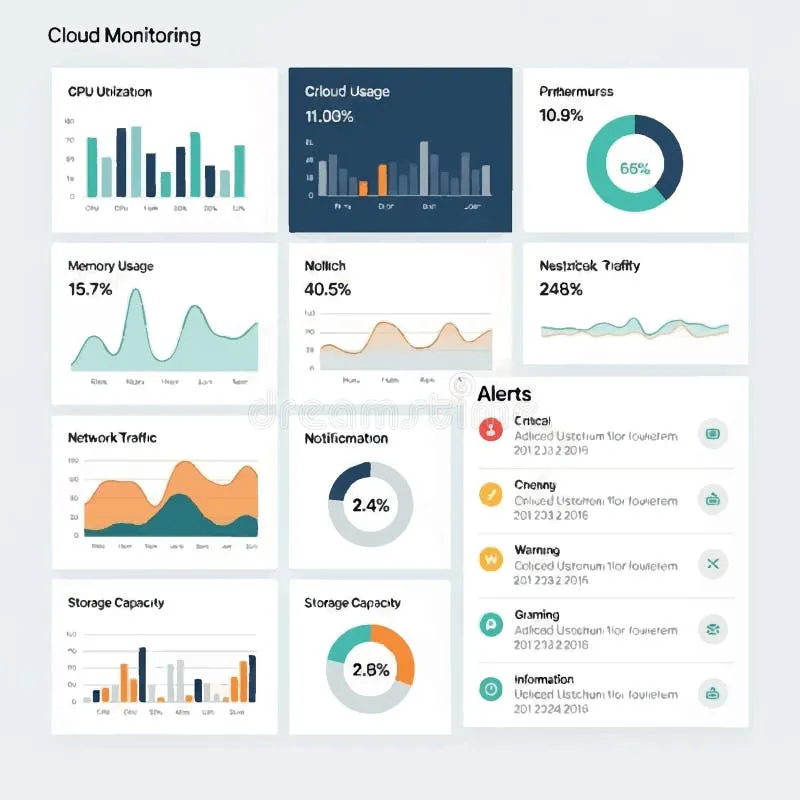
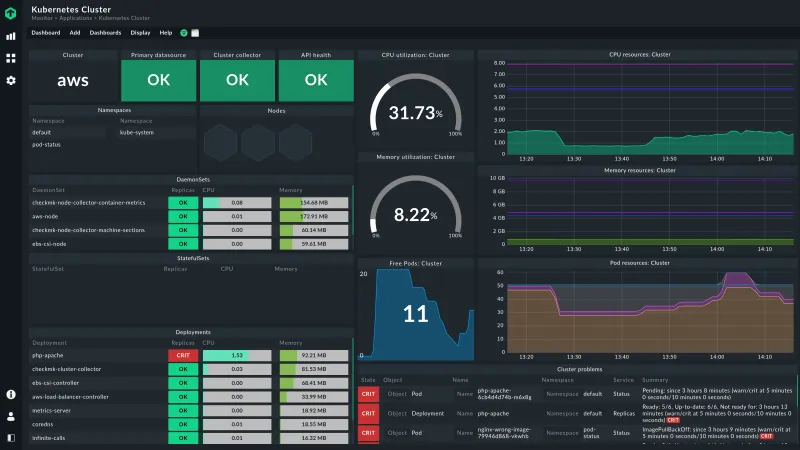
Most observability stacks are built around compute-centric metrics. CPU utilization, memory consumption, request throughput, and error rates are first-class signals. Data layer health — cache hit ratios, replication lag, pipeline consumer lag, consistency violation rates — is frequently treated as a secondary concern, monitored in a separate dashboard by a different team.
This organizational separation mirrors an architectural assumption that has not aged well: that data infrastructure is a stable substrate upon which elastic compute operates. In practice, data infrastructure is as dynamic and load-sensitive as the compute layer it supports. Treating it otherwise means that scaling events — the moments when infrastructure is most stressed — are also the moments when data layer anomalies are least likely to be detected in time to intervene.
The consequence is a class of performance degradation that appears, from a compute perspective, to be inexplicable. Nodes are healthy. CPU is well within bounds. Error rates are acceptable. And yet latency is elevated, user experience is degraded, and the engineering team is chasing a ghost through a dashboard that was never designed to find it.
Building for Data-Aware Elasticity
Addressing this gap requires a reorientation of how scaling readiness is defined and measured. Several principles are worth establishing as organizational standards.
Define scaling readiness at the data layer, not the compute layer. A node should not be considered production-ready until its cache state is sufficiently warm, its connection to upstream data sources is confirmed, and its read replica lag falls within acceptable bounds. Pre-warming strategies — including proactive cache population before a scaling event completes — can significantly reduce the cold-start penalty that undermines horizontal scaling performance.
Instrument data layer health as a first-class scaling signal. Replication lag, cache hit ratios, and pipeline consumer lag should feed directly into scaling decision logic, not just post-incident analysis. An auto-scaler that responds to CPU thresholds while ignoring database replication lag is operating with an incomplete model of system health.
Stress-test scaling events, not just steady-state performance. Load testing regimes that simulate sustained traffic frequently miss the transient failure modes that emerge during scaling transitions. Dedicated testing scenarios that evaluate system behavior during rapid scale-out — including cache warming dynamics and replication lag under load — provide significantly more predictive signal than steady-state benchmarks.
Align infrastructure and data engineering ownership. In many enterprises, compute infrastructure and data infrastructure are managed by separate teams with separate roadmaps. Closing the architectural gap between elastic compute and data readiness frequently requires organizational alignment before it requires technical solutions.
The Real Cost of the Gap
The financial and operational consequences of misaligned scaling are often masked by the metrics organizations use to evaluate infrastructure performance. Provisioning speed looks excellent. Node health metrics are green. And somewhere downstream, a data layer that cannot keep pace with the compute layer above it is quietly inflating latency, degrading consistency, and eroding the user experience that the entire scaling exercise was meant to protect.
Elastic infrastructure is a genuine capability. But elasticity applied only to compute, in an architecture where data systems operate on different timescales, produces a mirage: the appearance of scalable readiness without the substance of it. Closing that gap is not primarily a tooling problem. It is a design problem — and one that becomes significantly more expensive to address after the architecture has already been built around the assumption that compute elasticity is sufficient.