A Thousand Containers, Zero Accountability: How Containerization Created an Enterprise Governance Crisis
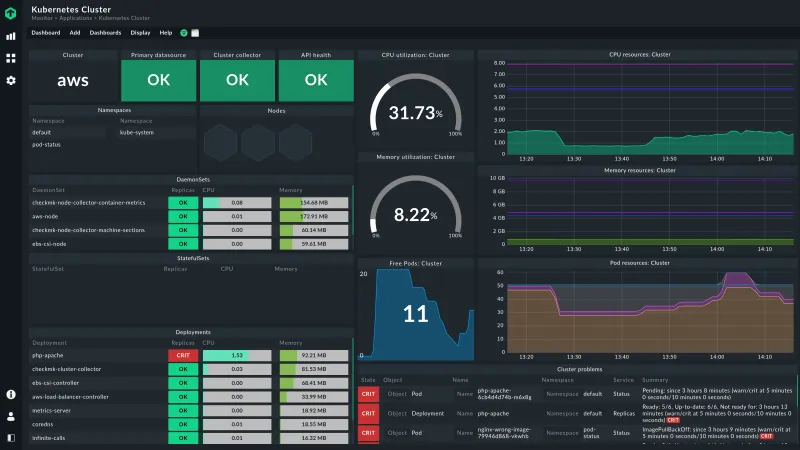
Photo: enterprise server room containers kubernetes infrastructure monitoring, via checkmk.com
When Docker democratized containerization in the early 2010s, the enterprise technology community greeted it with justified enthusiasm. Portability, consistency, and the ability to ship workloads across environments without friction — these were promises that resonated deeply with engineering teams burdened by configuration drift and environment-specific failure modes. A decade later, many of those same organizations are confronting an uncomfortable reality: the very speed at which they containerized their infrastructure has left them governing almost none of it.
This is the container sprawl problem. It is not a fringe concern limited to organizations with immature DevOps practices. It is playing out across Fortune 500 enterprises, regulated financial institutions, and large healthcare systems — anywhere that development velocity was prioritized over governance architecture. The containers proliferated. The oversight did not.
The Portability Promise and Its Hidden Consequence
Containerization's core value proposition was, at its heart, an elasticity argument. Workloads that could run identically across development, staging, and production environments were workloads that could scale faster, deploy more reliably, and move between infrastructure providers without costly re-engineering. For enterprises investing heavily in cloud-native strategies, containers became the foundational unit of modern deployment.
The problem is that portability also means mobility without inherent accountability. A container image, once built, can be replicated, modified, and deployed by virtually any team member with registry access. In organizations where dozens of development teams operate with significant autonomy — a model that accelerated dramatically during the distributed work era — container image creation became decentralized by design. What began as a handful of standardized base images quickly evolved into hundreds of custom variants, many of them undocumented, many of them running on base images that have not received a security patch in eighteen months or longer.
The numbers that have emerged from enterprise security audits are striking. Research from multiple infrastructure security firms consistently finds that a significant majority of container images running in production environments contain at least one known critical vulnerability. In many large organizations, the security team cannot even enumerate all running containers with confidence — let alone validate their patch status or confirm their compliance posture.
Why Compliance Frameworks Were Never Built for This Scale
Traditional enterprise compliance architecture was designed for a world of relatively stable, enumerable infrastructure. A physical server, a virtual machine, a named application instance — these were assets that could be catalogued, assigned ownership, and subjected to periodic review. The compliance cadence was quarterly, sometimes annual. The asset inventory was a spreadsheet, sometimes a configuration management database.
Containers operate on an entirely different temporal and volumetric scale. A single Kubernetes cluster running a microservices architecture may spin up and terminate thousands of container instances in a single business day. Many of those containers exist for minutes or hours before being replaced. The compliance frameworks governing them — if they exist at all — were often retrofitted from VM-era policies that bear little operational relevance to ephemeral, auto-scaled workloads.
This mismatch creates a genuine regulatory exposure for organizations operating in governed industries. Under frameworks such as PCI DSS, HIPAA, and SOC 2, the obligation to demonstrate control over systems processing sensitive data does not diminish because those systems happen to be containerized. Auditors are increasingly aware of this gap, and the questions being asked during compliance reviews have grown substantially more sophisticated. Claiming that containers are "outside scope" is no longer a defensible position in most regulated environments.
The Sprawl Mechanics: How Organizations Lost the Thread
Understanding how sprawl accumulates requires examining the organizational dynamics that enable it. In most enterprises, the path from a developer building a container image to that image running in production became remarkably short during the cloud-native adoption wave. CI/CD pipelines automated deployment. Registry access was broadly permissioned. Infrastructure-as-code made standing up new environments trivially easy.
What was not automated — or even consistently defined — was the governance layer. Questions such as who owns a given container image, which security scanning baseline applies to it, how long it is permitted to run before mandatory rotation, and which data classification rules govern the workloads it processes were frequently left unanswered. Not because organizations were indifferent to these questions, but because the tooling and policy frameworks needed to answer them at scale did not mature at the same pace as the deployment tooling.
The result is what security practitioners increasingly describe as a "ghost fleet" problem: containers running in production that no active team claims ownership of, often because the team that originally deployed them has been reorganized, the project has been deprecated, or the original deployment was a temporary proof-of-concept that simply never got cleaned up.
Practical Strategies for Recovering Governance Without Sacrificing Velocity
Restoring accountability to a containerized environment does not require dismantling the infrastructure flexibility that containers provide. It does require treating governance as a first-class engineering concern rather than a compliance checkbox applied after the fact.
Establish a mandatory image provenance standard. Every container image running in production should be traceable to an approved base image, a specific build pipeline, and a named owner. Organizations that have implemented image signing and provenance attestation — using tools such as Sigstore's Cosign or similar supply chain security frameworks — report significantly improved ability to audit running workloads and respond to newly disclosed vulnerabilities.
Implement continuous, automated vulnerability scanning. Point-in-time scanning during the build phase is necessary but insufficient. Container images that passed a vulnerability scan at build time may be running on base layers that are subsequently found to contain critical CVEs. Runtime scanning integrated with registry management allows security teams to identify affected containers across the entire fleet and prioritize remediation by exposure and data sensitivity.
Define and enforce container lifecycle policies. Ephemeral infrastructure should be governed by explicit lifecycle rules. Organizations that have implemented maximum runtime windows for container images — requiring that images older than a defined threshold be rebuilt from current base images before redeployment — have dramatically reduced the average age of their running container fleet and the associated vulnerability surface.
Align namespace and label architecture with compliance boundaries. Kubernetes namespaces and container labels are not merely organizational conveniences. Used deliberately, they become the structural foundation for applying compliance policies, network segmentation rules, and audit logging configurations at scale. Organizations that retrofit this structure after the fact face significant remediation effort; those that establish it as a deployment prerequisite from the outset maintain a far more governable environment.
Integrate security teams into platform engineering, not just audit cycles. Perhaps the most consequential organizational change available to enterprises struggling with container governance is relocating security expertise upstream. When security engineers are embedded in platform teams rather than engaged at the end of a deployment cycle, the policies that govern container deployment get built into the tooling itself — making compliant behavior the path of least resistance for development teams.
Elasticity Cannot Exist Without Accountability
The container sprawl problem is, at its core, a story about what happens when infrastructure elasticity outpaces the organizational and policy structures designed to govern it. The ability to scale workloads rapidly, deploy across environments seamlessly, and iterate at speed are genuine competitive advantages — but only when the systems delivering those capabilities can be accounted for, secured, and governed with equivalent rigor.
For enterprises serious about operating at scale, the lesson is not that containerization was a mistake. It is that elasticity and accountability are not opposing forces. They are complementary requirements. Organizations that treat governance architecture with the same engineering discipline they apply to deployment architecture will find that containers deliver on their original promise. Those that continue to treat compliance as an afterthought will find that their ghost fleets are growing faster than their ability to manage the consequences.